Interactive Valley
Frontend Consultant
Animation & Depth. A Website Built to Impress
The Challenge
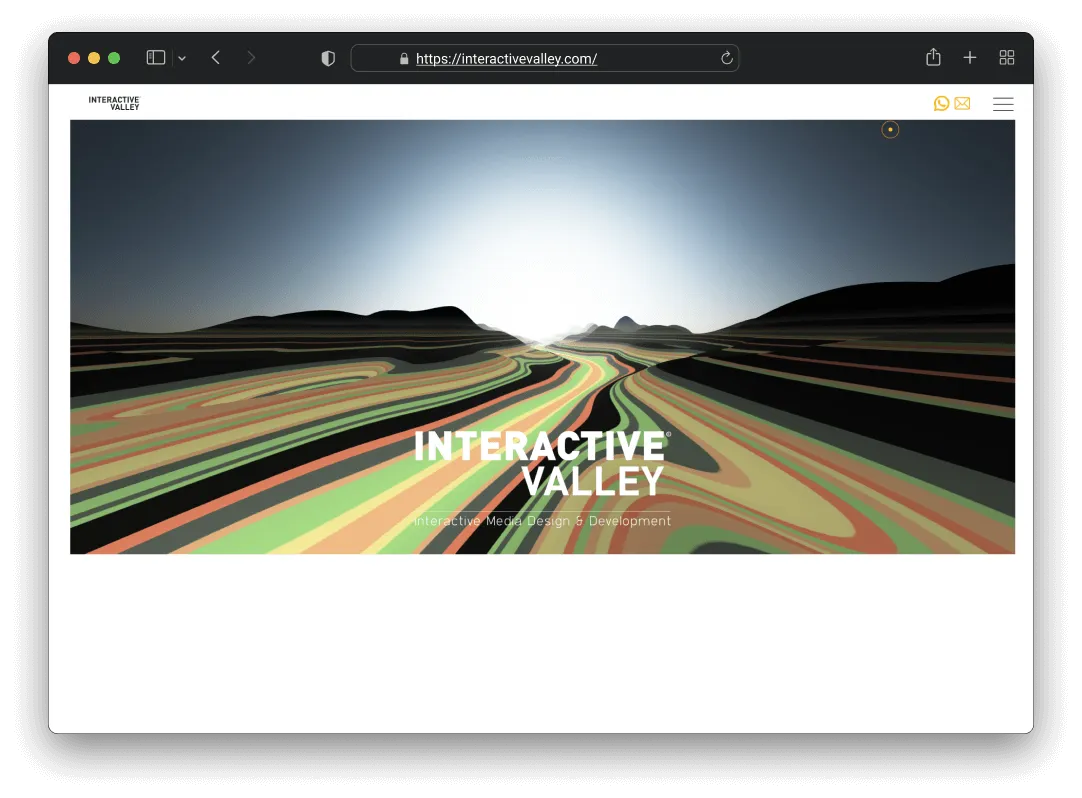
Interactive Valley is a creative agency that lives up to its name. They wanted a website that would be truly interactive and memorable. Not a portfolio that shows their work, but an experience that demonstrates their capabilities.
The problem: ambitious visuals often mean poor performance. How do you create an immersive 3D experience that still works on mid-range devices?
Key Decisions
Decision 1: Three.js Over WebGL Libraries
The situation: We needed a 3D hero section. Raw WebGL was too low-level. Unity was overkill.
Options considered:
- Babylon.js (powerful but larger bundle)
- Raw WebGL (full control but slow development)
- Three.js (good balance of power and simplicity)
What I chose: Three.js. The ecosystem, documentation, and community made development faster.
Tradeoff accepted: Slightly larger bundle than raw WebGL. But development time was cut significantly.
Decision 2: Procedural Terrain Over Pre-Made Assets
The situation: A static 3D scene would feel lifeless. Pre-made assets would limit flexibility.
What I chose: Procedurally generated terrain. The valley is created algorithmically, meaning it can adapt to different viewport sizes and animation states.
Tradeoff accepted: More complex code. But the dynamic feel was worth the complexity.
Decision 3: Progressive Enhancement for Performance
The situation: High-end Macs would run the full 3D experience beautifully. Budget Android phones would catch fire.
What I chose: Detect device capability and serve different experiences. High-end devices get the full 3D scene. Low-end devices get a simplified version with reduced polygons and simpler shaders.
Tradeoff accepted: More development time for multiple versions. But the site is usable for everyone, not just people with expensive hardware.
Decision 4: GSAP for Scroll-Based Animation
The situation: Scroll-based storytelling was central to the design. CSS scroll-snap felt too rigid.
What I chose: GSAP with ScrollTrigger. Fine-grained control over animation timing, scrubbing, and triggers.
Tradeoff accepted: Added a library dependency. But the level of control justified the weight.
Technical Implementation
- Lazy loading for Three.js scenes
- Frame rate monitoring with automatic quality reduction
- CSS containment for paint performance
- Mobile-specific animation adaptations
What This Proves
- Performance is a feature: The best animation is useless if it crashes the browser.
- Progressive enhancement scales: Building for the lowest common denominator, then enhancing, keeps everyone included.
- Tools should match the problem: Three.js was the right choice because the team could iterate quickly. Raw WebGL would have been impressive but impractical.
- Creative and technical are not opposites: The most impressive visuals came from tight technical constraints.
Have a similar project in mind?
Let's discuss how I can help bring your vision to life.
Book a Discovery Call